How to Write a Construction Risk Assessment UK: The Complete Guide for Site Teams in 2026

Every UK construction project — from a small residential extension to a multi-million-pound commercial development — requires a thorough risk assessment. It's not just a legal obligation under the Construction (Design and Management) Regulations 2015 (CDM 2015) and the Management of Health and Safety at Work Regulations 1999; it's the single most important document standing between your team and a preventable accident.
Yet despite its importance, construction risk assessments are frequently treated as a tick-box exercise. They're copied from project to project, rarely updated, and often sit in a filing cabinet rather than informing daily decisions on site.
This guide changes that. We'll walk you through how to write a construction risk assessment that genuinely protects your team, satisfies HSE inspectors, and becomes a living document that improves safety outcomes across every phase of your project.

What Is a Construction Risk Assessment?
A construction risk assessment is a systematic process of identifying hazards on a construction site, evaluating the likelihood and severity of harm they could cause, and determining appropriate control measures to eliminate or reduce those risks to an acceptable level.
Under UK law, the Health and Safety Executive (HSE) defines a risk assessment as a careful examination of what, in your work, could cause harm to people, so that you can weigh up whether you have taken enough precautions or should do more to prevent harm.
For construction specifically, risk assessments must consider:
- Site-specific hazards — ground conditions, adjacent buildings, overhead power lines, buried services
- Activity-specific hazards — working at height, excavation, demolition, hot works, lifting operations
- Environmental factors — weather conditions, noise, dust, contaminated land
- Human factors — fatigue, competence levels, lone working, language barriers
- Third-party risks — members of the public, neighbouring properties, traffic
Legal Requirements for Construction Risk Assessments in the UK
Understanding the legal framework is essential before you put pen to paper. Several pieces of legislation govern construction risk assessments in the UK:
CDM 2015 Regulations
The Construction (Design and Management) Regulations 2015 are the primary regulations governing health and safety in UK construction. Under CDM 2015:
- Clients must ensure suitable arrangements are in place for managing projects, including welfare facilities
- Principal designers must identify, eliminate, or control foreseeable risks during the design phase
- Principal contractors must plan, manage, and monitor the construction phase, including ensuring risk assessments are carried out
- Contractors must plan, manage, and monitor their own work and that of their workers
- Workers must report any safety concerns and cooperate with others on site
For projects with more than one contractor, a construction phase plan is required — and risk assessments form a critical component of this plan.
Management of Health and Safety at Work Regulations 1999
Regulation 3 requires every employer to carry out a suitable and sufficient assessment of risks to their employees and anyone else who may be affected by their work. If you employ five or more people, this assessment must be recorded in writing.
Work at Height Regulations 2005
Given that falls from height remain the leading cause of fatal injuries in UK construction, specific risk assessments for any work at height are essential. The regulations require employers to ensure that work at height is properly planned, supervised, and carried out by competent persons.
Other Relevant Regulations
- COSHH Regulations 2002 — for substances hazardous to health (cement dust, silica, solvents)
- LOLER 1998 — Lifting Operations and Lifting Equipment Regulations
- PUWER 1998 — Provision and Use of Work Equipment Regulations
- Noise at Work Regulations 2005
- Control of Asbestos Regulations 2012
The 5-Step Risk Assessment Process for Construction
The HSE recommends a straightforward five-step approach to risk assessment. Here's how to apply each step specifically to construction projects:
Step 1: Identify the Hazards
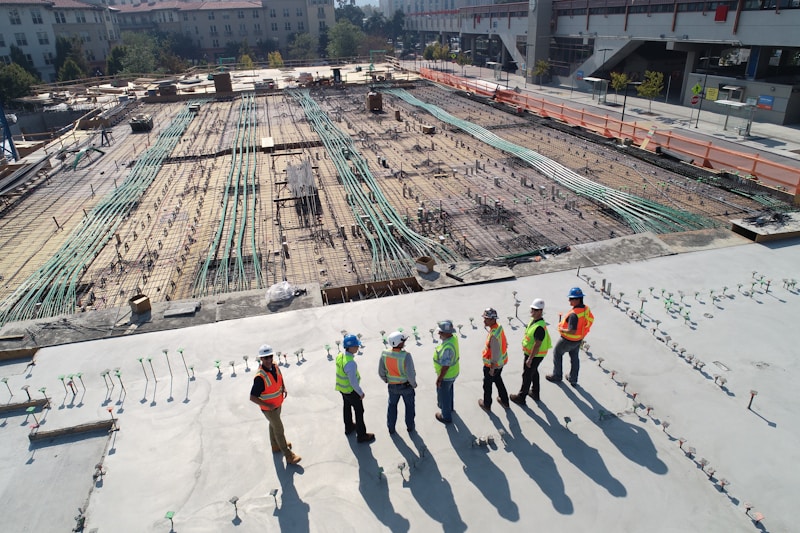
Walk the site. Talk to your workers. Review previous accident reports. Don't rely solely on generic hazard lists — every construction site is unique.
Practical methods for hazard identification:
- Physical site inspection — walk every area, including access routes, welfare facilities, and storage areas
- Task analysis — break each construction activity into individual steps and identify hazards at each stage
- Review incident data — check your own records and HSE construction statistics for common causes of injury
- Consult workers — your operatives know the risks better than anyone. Toolbox talks are an excellent forum for this
- Check manufacturer guidance — for equipment, materials, and substances
- Consider the environment — weather, lighting, ground conditions, neighbouring activities
Common construction hazards to check for:
- Falls from height — scaffolding, ladders, roof work, edge protection gaps, fragile surfaces
- Falling objects — unsecured materials, overhead works, crane operations
- Collapse — excavations, temporary structures, demolition, ground instability
- Vehicles and plant — reversing vehicles, mobile plant, delivery lorries, pedestrian interfaces
- Electrical — overhead power lines, buried cables, temporary electrical installations
- Manual handling — heavy materials, repetitive lifting, awkward positions
- Hazardous substances — cement, silica dust, asbestos, solvents, lead paint
- Noise and vibration — power tools, piling, compaction equipment
- Fire — hot works, flammable materials storage, temporary heating
- Confined spaces — manholes, tanks, ducts, enclosed areas with poor ventilation
Step 2: Decide Who Might Be Harmed and How
Don't just think about your direct employees. Consider:
- Site operatives — including subcontractors and agency workers
- Supervisors and managers who visit site regularly
- Visitors — clients, architects, building control officers
- Members of the public — pedestrians, nearby residents, motorists
- Young workers and apprentices who may lack experience
- Workers with disabilities or health conditions
- Delivery drivers entering and leaving site
- Maintenance workers who will work on the building after completion
For each group, consider how they interact with the hazard. A scaffolder faces different risks from the same scaffolding structure compared to a ground-level labourer.
Step 3: Evaluate the Risks and Decide on Precautions
This is where many risk assessments fall short. The goal is to determine whether existing controls are adequate or whether more needs to be done.
Use the risk matrix approach:
Rate each hazard for likelihood (1-5, from very unlikely to almost certain) and severity (1-5, from minor injury to fatality). Multiply to get a risk rating:
- 1-6 (Low risk) — acceptable with current controls, monitor regularly
- 7-12 (Medium risk) — improve controls where reasonably practicable
- 13-25 (High risk) — stop work until additional controls are in place
Apply the hierarchy of controls:
- Eliminate — can the hazard be removed entirely? (e.g., prefabricate off-site instead of working at height)
- Substitute — can a less hazardous alternative be used? (e.g., water-based paint instead of solvent-based)
- Engineering controls — physical barriers, guardrails, extraction systems
- Administrative controls — safe systems of work, permits, training, signage
- PPE — always the last resort, never the first response
Step 4: Record Your Findings and Implement Them
If you have five or more employees, you must record your risk assessment. But even for smaller firms, a written record is best practice — and essential evidence if anything goes wrong.
Your recorded assessment should include:
- The hazards identified
- Who is at risk
- Current control measures
- Risk rating (before and after controls)
- Additional controls required
- Who is responsible for implementation
- Target date for completion
- Date of assessment and assessor's name
The key is making this document accessible. A risk assessment buried in an office filing system is worthless. It needs to be on site, communicated to every worker, and referenced daily.
This is where digital tools make a genuine difference. Platforms like BRCKS allow site teams to share risk assessments instantly with every team member, ensuring everyone has access to the latest version on their phone — no more outdated paper copies floating around site. When a risk assessment is updated, the team is notified immediately rather than waiting for the next site induction or toolbox talk.
Step 5: Review and Update Regularly
A risk assessment is a living document. It must be reviewed:
- When work activities change — new phase, new subcontractor, different methodology
- After any incident or near miss
- When new information emerges — updated HSE guidance, manufacturer alerts
- When workers identify new hazards
- At regular intervals — monthly at minimum for ongoing projects
- When weather conditions change significantly
Risk Assessments for Common Construction Activities
Beyond the general site risk assessment, specific activities require their own detailed assessments. Here are the most critical:
Working at Height
Falls from height account for approximately 50% of construction fatalities in the UK. Your working at height risk assessment must address:
- Can the work be done from ground level instead?
- What access equipment is most appropriate? (scaffold, MEWP, podium steps)
- Is edge protection adequate?
- Are there fragile surfaces nearby?
- What rescue plan is in place if someone falls?
- Are workers trained and competent?
- What are the weather limits? (wind speed, rain, ice)
Excavations
Excavation collapses can be fatal within seconds. Your assessment must cover:
- Ground conditions and soil type
- Location of underground services (gas, electric, water, telecoms)
- Proximity to existing structures
- Support systems required (shoring, battering, stepping)
- Edge protection and barriers
- Access and egress for workers
- Water management (pumping, drainage)
- Vehicle movements near the excavation edge
Demolition
One of the highest-risk construction activities, demolition requires a specific method statement alongside the risk assessment. Key considerations:
- Structural survey and demolition sequence
- Asbestos survey results and removal plan
- Exclusion zones and public protection
- Noise and dust control
- Services disconnection
- Emergency procedures
Lifting Operations
Under LOLER 1998, every lifting operation must be properly planned by a competent person. Risk assessments for lifting must address:
- Load weight and centre of gravity
- Ground conditions at crane/equipment location
- Proximity to overhead power lines
- Wind speed limitations
- Exclusion zones beneath suspended loads
- Communication between crane operator, banksman, and riggers
Hot Works
Welding, cutting, grinding, and any work producing sparks or open flame requires specific assessment:
- Combustible materials within 10 metres
- Fire suppression equipment available
- Fire watch arrangements (during and after work)
- Permit to work system — see our guide on permit to work systems in UK construction
- Hot works screen and fire blankets

7 Common Mistakes in Construction Risk Assessments
After reviewing hundreds of construction risk assessments, these are the errors that appear time and again:
1. Copy-and-Paste Assessments
Using a generic template without tailoring it to your specific site and activities is the most common failing. HSE inspectors can spot a copied assessment immediately — and it won't protect your workers from site-specific hazards.
2. Failing to Consult Workers
Regulation 4A of CDM 2015 explicitly requires that workers are consulted and engaged in matters affecting their health and safety. Your operatives know the practical risks better than any desk-based assessor.
3. Treating It as a One-Off Exercise
A risk assessment written at the start of the project and never updated is almost as bad as having no assessment at all. Construction sites change daily — your risk assessments must keep pace.
4. Jumping Straight to PPE
PPE is the last line of defence, not the first. If your risk assessment's control measures column is filled with wear hard hat, hi-vis, and safety boots, you haven't properly applied the hierarchy of controls.
5. Ignoring Residual Risk
After applying controls, some risk remains. Your assessment must acknowledge this residual risk and confirm it's as low as reasonably practicable (ALARP).
6. Poor Communication of Findings
Writing a thorough risk assessment is pointless if workers don't know what's in it. Findings must be communicated through toolbox talks, site inductions, and ongoing briefings. Using a platform like BRCKS ensures documentation reaches every team member in real time, eliminating the I didn't know excuse.
7. Not Recording Near Misses
Near misses are free lessons. Every near miss should trigger a review of the relevant risk assessment. If your site isn't reporting near misses, it doesn't mean they're not happening — it means your reporting culture needs work.
Construction Risk Assessment Template
Here's a practical template structure you can adapt for your projects:
- Project name: [Your project]
- Site address: [Full address]
- Assessment date: [Date]
- Assessor name and role: [Name, position, qualifications]
- Activity/task: [Specific activity being assessed]
- Review date: [Scheduled review date]
For each hazard identified, record:
- Hazard description
- Who is at risk
- Existing controls
- Likelihood (1-5)
- Severity (1-5)
- Risk rating (L x S)
- Additional controls needed
- Responsible person
- Target date
- Residual risk level
Managing Risk Assessments Digitally
The days of paper-based risk assessments are numbered — and for good reason. Paper assessments get lost, damaged, and outdated. Digital management offers clear advantages:
- Version control — everyone always has the latest version
- Instant distribution — updates reach every worker immediately
- Audit trail — who read it, when, and any acknowledgements
- Easy updates — revise and re-distribute in minutes, not days
- Searchability — find any assessment instantly
- Integration — link to method statements, permits, and daily reports
Construction-specific communication platforms like BRCKS are purpose-built for this. Unlike WhatsApp groups where critical safety documents get buried beneath photos and banter, BRCKS organises project documentation so risk assessments are always accessible, current, and linked to the relevant project phase.
The Role of the Competent Person
Under CDM 2015, risk assessments must be carried out by a competent person — someone with sufficient training, experience, knowledge, and other qualities to carry out the task properly.
The Chartered Institute of Building (CIOB) and the Institution of Occupational Safety and Health (IOSH) both offer recognised qualifications. Common competence routes include:
- NEBOSH National Certificate in Construction Health and Safety — the industry gold standard
- IOSH Managing Safely — suitable for supervisors and managers
- CITB Site Management Safety Training Scheme (SMSTS) — for site managers
- CITB Site Supervisors Safety Training Scheme (SSSTS) — for site supervisors
Even if you hold qualifications, competence also requires practical experience of the type of construction work being assessed. A risk assessor experienced in commercial fit-out may not be competent to assess deep basement excavation.
What Happens If Your Risk Assessment Isn't Up to Standard?
The Health and Safety Executive takes construction safety seriously. In 2024/25, HSE conducted thousands of unannounced construction site inspections. Inadequate risk assessments can result in:
- Improvement notices — requiring you to fix deficiencies within a set timeframe
- Prohibition notices — stopping work immediately until risks are controlled
- Prosecution — fines have no upper limit under the Sentencing Council guidelines. In recent years, construction companies have received fines exceeding £1 million for safety failings
- Corporate manslaughter charges — in the most serious cases where gross negligence leads to death
Beyond enforcement, inadequate risk assessments can affect your:
- Insurance — claims may be rejected if risk assessments are inadequate
- Tender opportunities — clients increasingly require evidence of robust safety management during pre-qualification
- Reputation — in an industry built on trust, a poor safety record can be commercially devastating
Risk Assessment and the Building Safety Act 2022
The Building Safety Act 2022 has introduced additional requirements that affect how risk assessments feed into the wider safety case for higher-risk buildings (HRBs). Risk assessments now form part of the Golden Thread of information that must be maintained throughout a building's lifecycle.
For projects involving HRBs (residential buildings over 18 metres or 7 storeys), your risk assessments must be:
- Stored digitally as part of the Golden Thread
- Maintained in an accessible, searchable format
- Updated to reflect as-built conditions
- Handed over to the accountable person at completion
Practical Tips for Better Construction Risk Assessments
Drawing on guidance from the CIOB, RICS, and HSE, here are actionable tips to improve your risk assessments:
- Start during design — the earlier hazards are identified, the easier they are to design out. Work with your principal designer to address risks before they reach site
- Be specific — working at height is not a risk assessment. Installing roof trusses at 8m height using a 50-tonne mobile crane with restricted access on a sloping site adjacent to a live railway — that's specific
- Use plain language — your risk assessment needs to be understood by every worker on site, not just safety professionals
- Include photographs — a picture of the specific hazard location is worth a thousand words of description
- Set trigger points — define the conditions that would require a reassessment (e.g., wind speed exceeding 30mph for crane operations)
- Link to method statements — risk assessments identify what could go wrong; method statements describe how to do it safely. They work together
- Make them accessible — every worker should be able to access the relevant risk assessment for their current task within seconds, not hours. Digital tools make this achievable
- Involve the supply chain — subcontractors should contribute to and receive risk assessments. Effective subcontractor communication ensures nothing falls between the cracks
Frequently Asked Questions
Who is responsible for carrying out a construction risk assessment?
Under CDM 2015, the principal contractor is responsible for the overall construction phase risk assessment. However, every contractor on site must carry out risk assessments for their own work activities. The client also has duties to ensure suitable arrangements are in place. Ultimately, the employer is legally responsible for ensuring risk assessments are completed by a competent person.
How often should a construction risk assessment be reviewed?
There is no fixed legal frequency, but best practice suggests reviewing risk assessments at least monthly on active projects, and immediately after any incident, near miss, change in work activity, or when new information about hazards emerges. HSE guidance states they should be reviewed whenever there are changes that may affect risks.
Do I need a risk assessment for every task on a construction site?
You need risk assessments to cover all significant hazards. This doesn't necessarily mean a separate document for every minor task, but high-risk activities such as working at height, excavation, lifting operations, hot works, and working with hazardous substances each require specific, detailed assessments.
What qualifications do I need to write a construction risk assessment?
There is no single mandatory qualification. The law requires the assessor to be a competent person with adequate training, knowledge, experience, and ability. Common qualifications include the NEBOSH National Certificate in Construction, CITB SMSTS/SSSTS, and IOSH Managing Safely. However, qualifications alone aren't sufficient — practical site experience of the work being assessed is essential.
Can I use a generic risk assessment template?
You can use a template as a starting point, but it must be tailored to your specific site, project, and activities. HSE inspectors frequently cite generic, untailored risk assessments as a common failing. Every site has unique hazards, and your assessment must reflect the actual conditions and risks present.
What's the difference between a risk assessment and a method statement?
A risk assessment identifies hazards and evaluates the level of risk. A method statement describes the step-by-step process for carrying out the work safely. They complement each other — the risk assessment informs what controls are needed, and the method statement describes how those controls are implemented in practice. Together, they're commonly referred to as RAMS (Risk Assessment and Method Statement).
What happens if HSE finds my risk assessment inadequate?
HSE can issue an improvement notice requiring you to address deficiencies within a specified timeframe, or a prohibition notice stopping work immediately. In serious cases, prosecution can follow with unlimited fines. Under the Sentencing Council guidelines, construction companies have received fines exceeding £1 million for safety management failings.